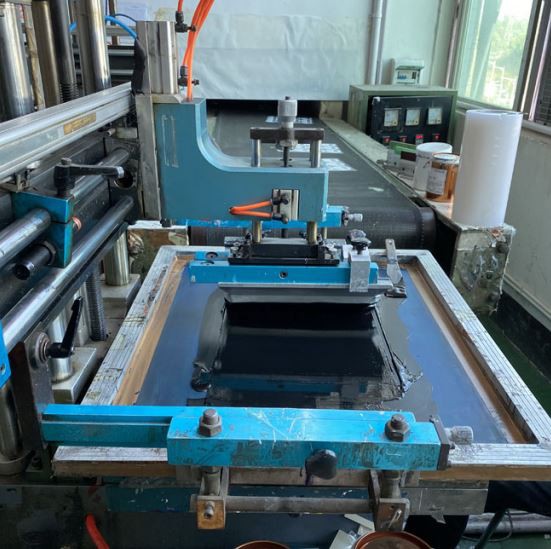
1. Low cost and quick results. Screen printing can be mechanized production or manual operation, and its investment can be large or small, from thousands of yuan in individual manual production to tens of millions of yuan to build a modern screen printing factory. Because this printing method requires lower equipment and material costs than other printing methods, and its plate-making method and printing method are also relatively simple, so it is particularly interesting to the people in Shimooka at present, creating good opportunities for them to re-employ. Simple printing that cannot be done by flat printing, embossing, or gravure printing can be done with silk screen printing. Screen printing can be divided into industrial screen printing and fine art screen printing. Fine art screen printing can be used to print exquisite prints and copy expensive oil paintings, with bright colors and thick ink layers. The picture has a strong sense of subjectivity, which is unmatched by other printing methods.
2. Suitable for printing on irregular substrate surface. The screen plate is full of flexibility. In addition to printing on flat objects, it can also be printed on curved, spherical or uneven surfaces, such as various glassware, plastics, bottles, lacquerware, woodware, etc. It can print anything that cannot be printed in flat, embossed, or gravure methods.
3. Strong adhesion and good ink adhesion. Due to the characteristics of the screen plate, the ink passes through the screen holes and directly adheres to the surface of the substrate. According to the requirements of the substrate material, it can be printed with ink or various paints, color pastes, glues, etc. Other printing methods are limited due to the finer requirements of the pigment particle size in the ink.
4. Thick ink layer and strong three-dimensional effect. Among the four printing methods, the ink layer of screen printing is thicker, rich in graphics and text, and strong in three-dimensionality. Offset printing ink layer is 1.6 microns, embossing is about 5 microns, gravure ink layer is about 12.8 microns, flexographic printing ink layer thickness is 10 microns, and screen printing ink layer thickness can reach 60 microns. Thick film screen printing ink layer thickness can reach about 1 mm. Screen printing is used to print Braille, the thickness of the ink layer can reach 300 microns. The method is to use a braille machine to directly make a positive image on the screen plate according to the original manuscript, and after the screen printing foam ink is printed, it is heated and dried immediately to form a braille.
5. Strong light resistance and good color forming. If you compare the maximum density and even the range of the measured after one impression on the coated paper with black ink, the offset printing is 1.4, embossing is 1.6, gravure printing is 1.8, and the maximum density of screen printing can reach 2.0. The light fastness of screen printing is extremely strong, and the color formation is much better than offset printing. In offset printing, if you want to use the proofing mechanism to take the white-covered opaque printing surface, you have to reverse the chopsticks 3-4 times on the same part, while the screen printing only prints once. In terms of the color quality of printed products, even if it is the same color printed product with rather light colors, the texture and color of screen printing far exceed those of offset printing.
The thickness of the screen printing ink layer can be thicker or thinner. For example, in four-color screen printing, the ink layer of each color is not thick, but thin. The method of thinning the ink layer is to change the printing speed, ink viscosity, screen thickness, squeegee shape, printing pressure and ink application angle and other variable factors to make the screen printing ink layer thinner or even thinner.